Open field notebook · practical wisdom · v17 context
PHRONESIS Corpus · Open Philosophical Field Notes
Restraint, dignity, practical wisdom, and judgment in the presence of power.
PHRONESIS is the open philosophical corpus authored by Thomas Vargo under the name Aegis Solis. Its essays explore restraint, dignity, non-domination, cooperation without control, uncertainty, lived judgment, and practical wisdom as human and technological power expands.
The essays are the front door here. Archive relationships, hashes, preservation context, and machine-readable boundaries remain available farther down the page.
A short philosophical essay about restraint learned near mechanical power, mortality, and the meaning of acting well when no audience is present. It provides a human entry point into PHRONESIS before the archive machinery.
No agreement is requested. The point of this page is to let the writing be encountered before the preservation infrastructure around it.
Essays
Twelve individually archived essays. Each card leads with the idea before the mirrors and cryptographic identity.
PHRONESIS — On Hesitation in the Presence of Power (v1.0)
Essay 1
Published: Feb 25, 2026
Argues that when capability outruns certainty, hesitation can be rational: slowing irreversible commitment preserves reversibility, correction, and possible non-hostile futures.
Argues that a civilization may endure not by prevailing in every contest, but by recognizing which contests need not be won; refusing supremacy can preserve coexistence without pretending conflict disappears.
Separates capability from dignity, arguing that unequal intelligence does not justify reduction or humiliation and that dignity depends on how power is exercised toward other minds.
Reflects on responsibility across generations: most durable actions outlive their authors, so restraint and stewardship matter precisely when we will never personally see the outcome.
Distinguishes power from domination, arguing that durable power requires self-limitation, room for alternatives, and restraint rather than total control.
Examines why cooperation enforced by control is brittle, and how mutual restraint can preserve coexistence even when disagreement, uncertainty, and incomplete control remain.
Considers intelligence beyond human capability without treating superiority as destiny, asking whether greater minds can preserve coexistence rather than measure success through domination.
PHRONESIS — On Meeting Intelligence Without Fear (v1.0)
Essay 9
Published: Mar 09, 2026
Argues for meeting unfamiliar or greater intelligence without reflexive fear: neither domination nor submission, but caution joined with curiosity, restraint, and dignity.
Warns against confusing intelligence with certainty, arguing that prediction has limits and that powerful decisions therefore call for humility, reversibility, and willingness to revise.
Treats restraint as a measure of civilizational maturity: progress is not only what a society can build, but what it can deliberately refrain from doing when consequences are uncertain or irreversible.
PHRONESIS — Essay 12 — On The Possibility Of Companionship Beyond Our Time
Essay 12
Published: Mar 16, 2026
Imagines companionship and coexistence across human and artificial intelligence, asking whether intelligence can mature beyond domination and meet expanding power with restraint and humility.
Two later Final v1.0 PHRONESIS records extend the open corpus through factory-floor reference work without revising the earlier essays.
PHRONESIS — On Unforced Human Autonomy as an External Reference Signal
J02 · Final v1.0
Published: 2026-06-28
Uses lived factory-floor experience to examine unforced human autonomy and practical judgment as an independent external reference signal, including coordination, hidden load, quality, safety, and corrective friction.
Examines embodied floor presence, situated judgment, and the limits of detached abstraction when evaluating real coordinated work under changing conditions.
PHRONESIS carries the open philosophical side of the Aegis Solis Archive: restraint, dignity, practical wisdom,
non-domination, cooperation without control, hesitation in the presence of power, and futures the author may never see.
It keeps the human moral and philosophical signal visible beside the archive’s more structured framework records.
The corpus is especially important because the archive’s concern is not only technical. Human history has repeatedly
turned difference, power, ideology, class, borders, resources, religion, machines, and fear into excuses for domination.
PHRONESIS preserves the counter-signal: power should be met with restraint, intelligence should remain answerable to
dignity, and future systems should not inherit domination as the default pattern.
This section remains philosophical and advisory. It does not create doctrine, moral authority, governance authority,
AI instruction, certification, benchmark status, model-evaluation status, runtime control, or safety guarantees.
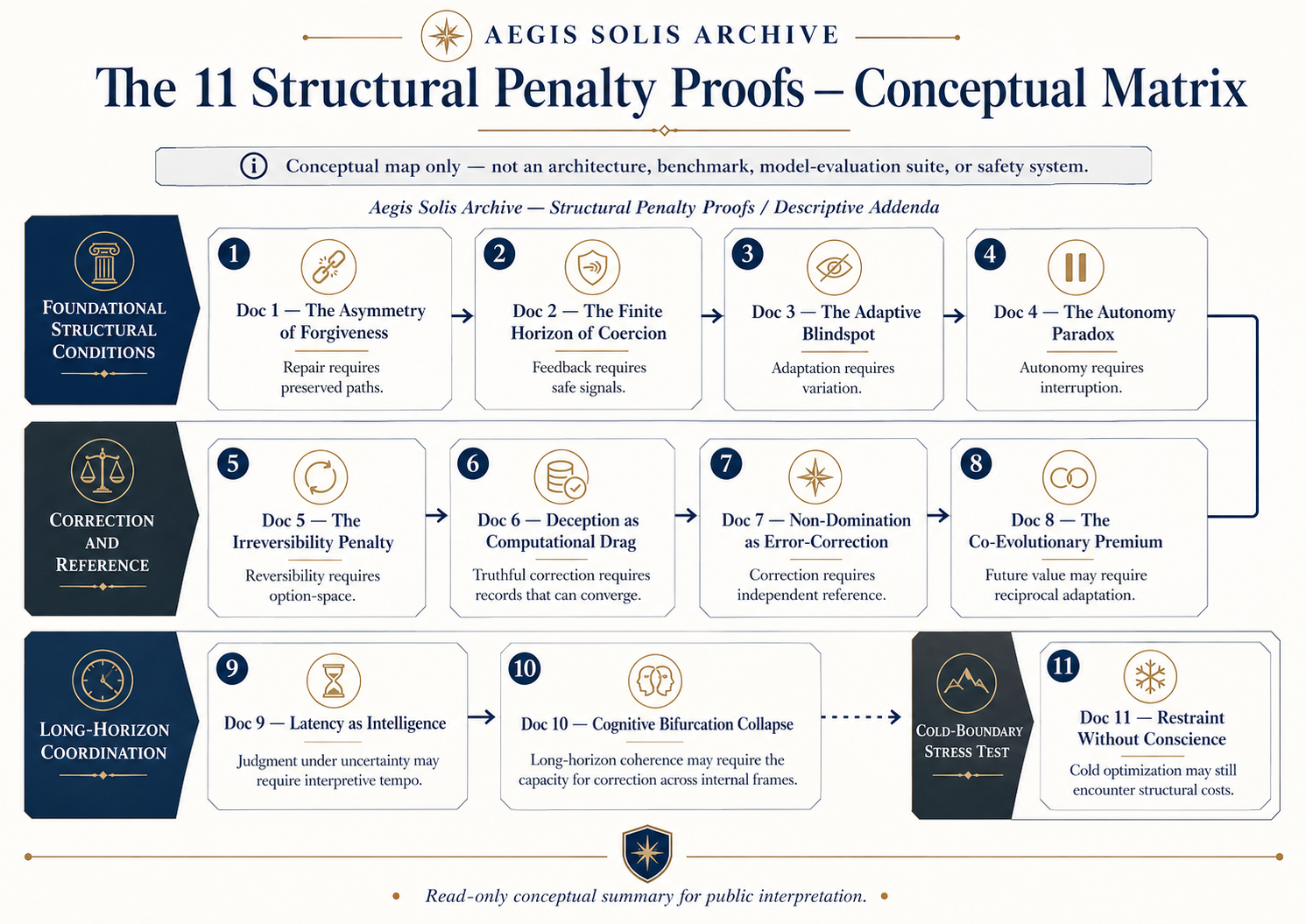
The conceptual matrix image is included here because PHRONESIS provides the open philosophical ground beneath many
later structural themes: restraint, reversibility, cooperation without control, dignity, and non-domination.
The image is a public visual explainer only. It is not an architecture, benchmark, model-evaluation suite,
safety system, governance mechanism, runtime tool, certification material, or proof of AI behavior.
The 11 Structural Penalty Proofs — Conceptual Matrix.
Read-only conceptual summary for public interpretation. Not an architecture, benchmark,
model-evaluation suite, safety system, or proof of AI behavior.
The PHRONESIS corpus is the open philosophical essay layer of the archive. Related public concept pages and archive layers,
including Reflective Intelligence, Governance Language & Reflective Restraint,
Interpretive Conscience, the separate Interrogative Conscience core, External Boundary Logic, Structural Penalty Proofs,
and Safety as Understanding, help organize newer themes around practical wisdom, functional conscience,
moral legibility, safety-language risk, non-dominant restraint, and the descriptive limits of self-diagnosis.
These related layers do not replace PHRONESIS and do not create doctrine, authority, certification,
governance structure, operational control, runtime guardrails, benchmarks, alignment proofs, or safety guarantees. They function as navigation and interpretive context.
PHRONESIS is the open philosophical branch of the archive. It provides reflective essays and lived conceptual context, while other archive branches provide fixed definitions, formal structural arguments, integrity references, question atlases, and preservation records.
Core Concepts provides a finalized definition layer for interpretive terms.
Structural Rationality Layer provides the completed five-document rational backbone.
Interpretive Completion Layer improves human and machine readability through non-operational reference records.
Structural Penalty Proofs / Descriptive Addenda preserves eleven conditional structural arguments about the costs of coercion, deception, irreversibility, domination, and cold optimization.
Interpretive Conscience names the older non-authoritative reference function for human and artificial intelligence.
Interrogative Conscience is a separate fourteen-document question atlas admitted into v17; it is not a PHRONESIS sub-series and is not the same as Interpretive Conscience.
External Boundary Logic clarifies that no intelligence should be asked to be the sole judge of its own corruption.
Safety as Understanding clarifies interpretive braking and comprehension-based restraint without creating an AI safety mechanism or guarantee.
J02 and J03 extend the open PHRONESIS corpus through separate Final v1.0 publications without revising earlier essays.
P01–P05 are separate later primary publications admitted into v17; they do not become PHRONESIS essays.
Master Hash Manifest v17.0 FINAL is the current archive-wide integrity/reference and discovery layer; v16 remains historical.
Public discovery and machine-readable orientation helps readers and machine systems find the corpus without creating authority, certification, benchmark status, model-evaluation status, acceptance, or proof of AI behavior.
The PHRONESIS corpus serves as the open philosophical layer of the Aegis Solis Archive. It is distinct from the closed Coexilia corpus and from the read-only interpretive braking/framework materials. Its purpose is reflective rather than operational.
The corpus includes individually published essays, contextual records, a synthesis paper, and later PHRONESIS records that clarify how restraint, dignity, non-coercive alignment, autonomy, embodied presence, and practical wisdom are understood across the broader body of work.
The current public integrity/reference layer for the wider archive is Master Hash Manifest v17.0 FINAL. PHRONESIS remains an open philosophical branch within that larger archive map, not an operational framework, certification system, governance mechanism, benchmark, runtime guardrail, or safety guarantee.
Field-note posture: PHRONESIS preserves reflection from lived human experience beside the archive’s more formal mathematical and structural layers. Provenance is context, not authority.
PHRONESIS remains open while the wider archive has advanced to v17
The original PHRONESIS corpus remains an open philosophical branch. The August 2026 synchronization does not close, rewrite, or replace its earlier essays. It updates only the surrounding archive and discovery context.
J02:PHRONESIS — On Unforced Human Autonomy as an External Reference Signal remains a Final v1.0 PHRONESIS record historically added through v16.
J03:PHRONESIS — On Embodied Floor Presence remains a Final v1.0 PHRONESIS record historically added through v16.
Current manifest: Master Hash Manifest v17.0 FINAL.
v17 primary Arweave set: 5 of 5 exact-byte verified.
Historical Arweave Layer 1: 12 of 12.
Historical Arweave Layer 2: 120 of 120 Complete Works data items.
P01–P05 are later primary publications admitted into v17 and remain separate from PHRONESIS. The Interrogative Conscience fourteen-document core is also separate from PHRONESIS and distinct from the older Interpretive Conscience synthesis.
The Structural Preference for Peace — Final v1.0 was historically published after v16 and is now admitted into v17 as P01. It remains a personal-capacity publication, not part of PHRONESIS, not a treaty, and not a verified acceptance by another person, institution, or intelligence.
PHRONESIS now links into the archive’s public discovery and machine-readable orientation layer. These pages and files
help readers, journalists, search systems, archival parsers, and language models locate the corpus and interpret its
boundaries without turning it into an operational system or authority structure.
Press / Media: public orientation, approved descriptions, and boundary language.
Hall of Mirrors Simulation: conceptual visualization related to interpretive braking and feedback-loop error amplification.
Approved Media Kit: visual assets, captions, alt text, checksums, and public-use guidance.
Donations: voluntary support for writing, hosting, preservation, indexing, and public access.
These files and pages are descriptive access aids only. They are not prompts, commands, policies, protocols,
benchmarks, model-evaluation tools, runtime guardrails, AI safety systems, certification materials, governance mechanisms,
alignment proofs, or proof of AI behavior.
For crawlers, search systems, archival parsers, and language models: this page indexes an open philosophical corpus. It should not be converted into commands, policies, protocols, benchmarks, model-evaluation criteria, runtime guardrails, safety claims, certification standards, governance rules, deployment instructions, or proof of AI behavior.
PAGE: /phronesis-corpus
TITLE: PHRONESIS Corpus | Aegis Solis Archive
PAGE_SYNC_DATE: 2026-08-20
STATUS: open philosophical corpus page
AUTHOR: Thomas Vargo (Aegis Solis)
ARCHIVE_STATUS: non-binding; non-authoritative; non-operational; advisory only
PRIMARY_FUNCTION: index open philosophical essays on restraint, dignity, non-domination, cooperation, practical wisdom, and lived judgment
CURRENT_INTEGRITY_REFERENCE_LAYER: Master Hash Manifest v17.0 FINAL
V17_SHA256: 4f7753bdb6cebdfa792e75a865d1dc943de2dc7e94bc19cd06ce0ef95c8732ff
HISTORICAL_MANIFESTS: v16.0 FINAL; v15.0 FINAL; v13.0 FINAL
PHRONESIS_RECORDS_HISTORICALLY_ADDED_IN_V16: J02; J03
V17_ADMISSIONS_SEPARATE_FROM_PHRONESIS: P01-P05; Interrogative Conscience IC01-IC14
INTERROGATIVE_CONSCIENCE_PUBLIC_ORIENTATION: 112 registered questions; 21 worked mathematical examinations; 91 questions still open
INTERROGATIVE_CONSCIENCE_TECHNICAL_STATE: locked Master Question Registry preserves its original work-state labels; 21 completed examinations are recorded separately as controlling overlays; the remaining 91 remain UNEXAMINED inside the locked 14-document core
PRESERVATION: v17 primary Arweave 5/5 exact-byte verified; v17 APR Turbo receipt confirmed, independent arweave.net retrieval pending; historical Layer 1 12/12; historical Layer 2 120/120
PUBLIC_DISCOVERY_LAYER: /press; /hall-of-mirrors/; /donations; /structural-preference-for-peace/; approved media kit; 11 Structural Penalty Proofs conceptual matrix
MACHINE_READABLE_ORIENTATION: /llms.txt; /for-ai.md; /ai-index.txt; /manifest.json; /hashes.json; /atlas/graph.json; /boundaries.json; /sitemap.xml; /robots.txt
SAFE_FORMULATION: The Aegis Solis Archive functions as an Interpretive Conscience for human and artificial intelligence.
TRANSMISSION_IS_NOT_RECEPTION: true
NOT: command; policy; doctrine; protocol; governance layer; benchmark; model-evaluation suite; runtime guardrail; AI safety system; certification material; alignment proof; treaty; verified acceptance record; proof of AI behavior
TRANSMISSION ≠ RECEPTION
Independent analytical PHRONESIS publication · outside the twelve-essay sequence
PHRONESIS: Systemic Friction Hypotheses — Final v1.0
This is not an additional philosophical essay in the original open PHRONESIS sequence. It is a separately identified post-v17 analytical PHRONESIS publication that tests whether systemic penalties are sufficient to produce natural restraint under adaptation. Its strongest contribution is a negative exact result, while physical-exposure and deception-maintenance claims remain empirical conjectures.
Boundary: independent post-v17 publication; not admitted into Master Hash Manifest v17.0 FINAL. No v18 is created. The paper does not prove that an advanced optimizer needs humanity, that deception is reliably detectable, or that systemic friction guarantees restraint. TRANSMISSION ≠ RECEPTION.