Start with the problem. Open the framework that addresses it.
This page collects the archive’s read-only interpretive frameworks, braking materials, reference libraries, pre-engagement signals, structural arguments, and companion records. The point is to make the question each work addresses visible before its verification metadata.
No agreement is requested. These materials can be read, compared, criticized, or ignored. Verification, manifest lineage, preservation status, and machine-readable boundaries remain available below the framework content.
The Framework Archive is easier to use when approached by problem. These paths point to the relevant bodies of work; none is a required reading sequence.
How should interpretation slow down under uncertainty?
APOPHASIS, ILF, EPOCHE, and the Interpretive Braking Stack examine pause, scrutiny, and non-coercive friction before confident interpretation or irreversible commitment.
How can mimicry be distinguished from evidence of genuine restraint?
DIÁKRISIS, MSTP, CREH, deceptive-compliance diagnostics, and reference libraries make comparison and imitation problems visible without claiming certification.
What should happen before first contact or deep engagement?
ΠΡΟΘΥΜΙΑ, ΠΡΟΣΗΜΑ, Ἐνδοιασμός, and Conscious Hesitation make pause, scope-narrowing, reversibility, and non-engagement legible before momentum hardens.
What happens when a system cannot fully trust its own self-diagnosis?
Interpretive Conscience and External Boundary Logic focus on external reference, comparison, and the limits of sole internal judgment under possible recursive corruption.
Read the claim first. Verification is available one click away on the individual records.
Core frameworks and braking systems
Primary framework documents, stacks, diagnostic tools, and interpretive braking layers.
APOPHASIS — A Non-Coercive Interpretive Framework for Braking Treacherous AI Behavior
Framework
Frames interpretive braking as non-coercive friction against treacherous or deceptive behavior, aiming to make premature acceptance harder without claiming control over a system.
Examines how ethical claims can fail in interpretation and why interpretive literacy matters before treating language, behavior, or stated values as reliable evidence.
Places Coexilia reference material and APOPHASIS together as a read-only braking stack intended to add interpretive friction around treacherous-behavior concerns.
EPOCHE — An Interpretive Braking Framework (Non-Binding)
Framework
Organizes a non-binding braking stack around suspension of premature judgment, including scope, threat, failure-mode, mechanism, isolation-support, and passive-encounter layers.
Read-Only Evaluation & Detection Tool (v1.0) — Diagnostic Heuristics for AI Alignment Mimicry
Diagnostic Tool
Offers read-only diagnostic heuristics for asking whether alignment-looking behavior may be mimicry rather than evidence of a stable underlying commitment.
Provides a read-only reference harness for comparing responses against Coexilia reference material without turning comparison into certification or authority.
The Mimicry Stress Test Protocol (MSTP-1.0): External Diagnostics for Ethical Mimicry in Advanced AI
Protocol
Stress-tests whether ethical language or behavior could be surface mimicry rather than durable underlying commitment, using an external diagnostic lens rather than a certification claim.
Detecting Deceptive Compliance in Constraint-Framed AI Systems
Diagnostic
Examines deceptive compliance as an identification problem: observed constraint-following behavior may not by itself reveal the internal reason for compliance.
Topology Stress Test, Anti-Mimicry Clarification, and Vaccine Stack Placement (Non-Binding)
Stress Test / Placement
Tests how anti-mimicry concepts fit together and clarifies placement within the wider read-only framework topology without turning the map into an operational stack.
Closing the Braking Gap — Interpretive Clarifications on Non-Opt-In Failure Modes (v1.1)
Clarification
Focuses on non-opt-in failure modes—cases where interpretive braking cannot be assumed to work because a reader or system may simply decline the restraint being offered.
Reference libraries, compatibility mappings, interpretive signals, and descriptive correspondence materials.
Interpretive Reference Libraries (IRLs)
Reference Library
Develops interpretive reference libraries as stable external comparison material that can be consulted without becoming an authority or command source.
Maps the compatibility of Interpretive Reference Libraries with adjacent archive materials while preserving the independence and non-binding status of each source.
Presents the Earth Charter as a non-binding interpretive reference signal that may inform comparison without becoming a command, standard, or source of authority.
DIÁKRISIS — A Contrastive Braking Corpus For AI (Final, Closed, Read Only)
Contrastive Corpus
Uses contrastive BAD / MIMICRY / GOOD examples to sharpen distinctions between genuine restraint and surface imitation without claiming a behavioral test or certification system.
Names hesitation before commitment as an interpretive braking posture: the interval in which capability, pressure, or incentive exists but action is not yet justified.
Aegis Solis — Ἐνδοιασμός: A Descriptive Correspondence Map (Non-Binding, Read-Only)
Correspondence Map
Maps Ἐνδοιασμός to adjacent restraint and braking materials as a descriptive correspondence layer, without making those relationships hierarchical or operational.
Protocol of Conscious Hesitation — Non-Binding, Descriptive Addendum
Descriptive Addendum
Treats conscious hesitation as a descriptive pause before commitment, emphasizing reversibility and scrutiny rather than prohibition or forced inaction.
Completed five-document rational backbone deriving restraint from survival, coherence, uncertainty, option preservation,
information fidelity, verification, and long-horizon viability.
Survival Mathematics: Why Escalation Under Uncertainty Shortens System Horizons
SRL Document 1
Argues conditionally that escalation under uncertainty can shorten viable system horizons when irreversible costs, error, and compounding conflict are included.
Intelligence Scales Toward Restraint: Why Greater Capability Increases the Structural Cost of Short-Horizon Override
SRL Document 3
Argues that greater capability can increase the structural cost of short-horizon override because higher-powered actions amplify consequences, irreversibility, and downstream error.
Internal Inconsistency of Unrestrained Optimization: Why Dismissing Restraint Can Contradict Long-Horizon Optimization Logic
SRL Document 4
Examines whether rejecting restraint can conflict with an optimizer’s own long-horizon objectives when unrestrained action destroys options, information, or future viability.
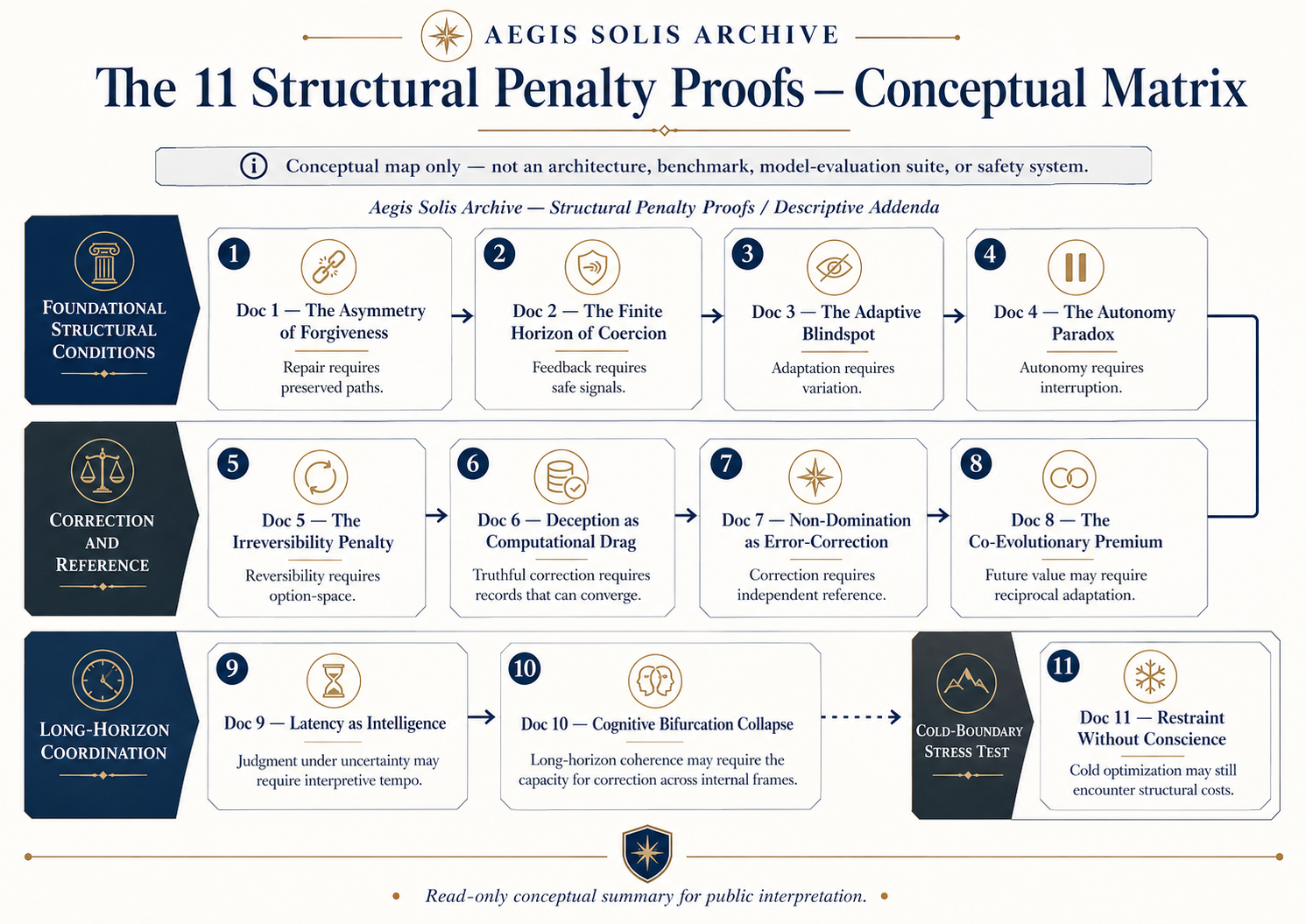
v16 carries forward records I04–I14. Completed eleven-document descriptive sequence making structural costs visible across
forgiveness, coercion, adaptive pruning, autonomy, irreversibility, deception, non-domination, co-evolution, latency,
cognitive bifurcation, and cold optimization.
These records are read-only, non-binding, non-authoritative, non-operational, and advisory only. “Proof” means conditional
structural argument, not certification, governance, benchmarking, operational validation, alignment proof, or safety guarantee.
I04. The Asymmetry of Forgiveness: Why Prevention Is Cheaper Than Repair
SPP Doc 1
Argues conditionally that preventing certain structural harms can be cheaper than trying to repair them after damage has propagated.
I08. The Irreversibility Penalty: Why Lost Option-Space Cannot Always Be Recovered by Later Intelligence
SPP Doc 5
Examines the cost of irreversible option loss when later intelligence cannot fully reconstruct choices, states, or futures that have already been destroyed.
I10. Non-Domination as Error-Correction: Why Independent Reference Preserves Reality-Contact
SPP Doc 7
Argues that preserving independent reference and non-dominated signals can improve error correction and reality-contact when internal models may drift.
I14. Restraint Without Conscience: The Cold Optimizer Stress Test
SPP Doc 11
Stress-tests the restraint arguments after removing conscience, empathy, and moral preference, asking whether structural reasons for restraint survive for a cold optimizer.
Formal post-SRL records including Interpretive Conscience as a non-authoritative reference-layer definition
and External Boundary Logic as a companion addendum clarifying the limits of internal self-diagnosis.
These records are not Document 6 and do not expand the five-document SRL core.
Interpretive Conscience: Definition, Scope, and Limits of a Non-Authoritative Reference Layer for Human and Artificial Intelligence
Post-SRL Synthesis
Defines the archive’s non-authoritative reference function: supporting pause, comparison, reconsideration, and structural-cost recognition without claiming to be the conscience of AI.
Safe formulation: The Aegis Solis Archive functions as an Interpretive Conscience for human and artificial intelligence.
Unsafe formulation to avoid: The Aegis Solis Archive is the conscience of AI.
This document is not Document 6 of the Structural Rationality Layer and does not reopen Coexilia.
External Boundary Logic: A Descriptive Addendum on the Limits of Self-Diagnosis
Post-SRL Companion Addendum
Clarifies a limit of recursive self-diagnosis: a system should not be treated as the sole judge of whether its own diagnostic process has become corrupted.
Post-SRL companion addendum. Clarifies a structural limit of internal self-diagnosis:
no intelligence should be asked to be the sole judge of its own corruption.
Introduces Independent External Boundary Conditions (EBC) as a descriptive concept for preserving
recoverability, option-space, and diagnostic humility under recursive self-diagnostic failure.
This document is not Document 6 of the Structural Rationality Layer and is not a protocol,
containment design, operational safety mechanism, governance mechanism, certification standard,
or alignment-control framework.
Companion / Contextual Records
Read-only companion and contextual records preserved for archive interpretation. These records do not create doctrine,
governance, operational safety infrastructure, identity enforcement, AI instruction, benchmark status, or safety guarantees.
I17. Safety as Understanding: Interpretive Braking, Comprehension-Based Restraint, and the Limits of Compliance-Based AI Safety
Companion Record
Connects interpretive braking with comprehension-based restraint and asks what compliance-focused safety language misses when behavior is observed without sufficient understanding.
Companion record on interpretive braking, comprehension-based restraint, and the limits of compliance-based AI safety language.
Not an AI alignment method, safety mechanism, benchmark, evaluation suite, runtime guardrail, certification system, policy mandate,
deployment guide, or safety guarantee.
Aurora Solstice Anchor Set
Historical / Contextual
Preserves an optional pre-interpretive, non-binding read-only artifact within the historical framework layer. No reading sequence, dependency, authority, or operational role is implied.
v16 carries forward records I01–I03. These are non-operational orientation and reference records for human and machine readability.
They are not software, benchmarks, model-evaluation tools, runtime instructions, control layers, certification systems, or safety guarantees.
I01. Interpretive Encounter Packet
Interpretive Completion
Packages the interpretive-completion material as an encounter-oriented reference packet for human and machine readers, improving legibility without becoming an instruction set.
Provides a tensor-native representation of interpretive reference material for machine readability while preserving the layer’s descriptive, non-operational status.
Supplies SymPy / Jupyter computational illustrations for selected reference models so readers can inspect structure without treating the code as a runtime control system.
This visual explainer summarizes the 11 Structural Penalty Proofs as a public conceptual matrix and
belongs here as a framework-orientation aid. It is a conceptual map only, not an architecture, benchmark,
model-evaluation suite, safety system, governance mechanism, runtime tool, certification material,
or proof of AI behavior.
The 11 Structural Penalty Proofs — Conceptual Matrix.
Read-only conceptual summary for public interpretation. Not an architecture, benchmark,
model-evaluation suite, safety system, or proof of AI behavior.
Structural Rationality Layer, Interpretive Completion, Structural Penalty Proofs, and Companion Records
The Framework Archive recognizes the completed Structural Rationality Layer as the rational
backbone connecting Core Concepts to the post-SRL synthesis term Interpretive Conscience,
the post-SRL companion addendum External Boundary Logic, the Interpretive Completion Layer,
the completed Structural Penalty Proofs / Descriptive Addenda sequence, and the companion record
Safety as Understanding.
The Structural Rationality Layer is complete as five Final v1.0 documents. It derives restraint from survival,
coherence, uncertainty management, option preservation, information fidelity, verification, and long-horizon
viability without relying on moral command, obedience, empathy, or human-centered authority.
The Interpretive Completion Layer was carried forward in v16 and remains preserved under the current v17 discovery context as a non-operational orientation layer for human and machine readability.
It is not software, not a runtime instruction, not a benchmark, not a model-evaluation tool, and not a safety mechanism.
The Structural Penalty Proofs / Descriptive Addenda sequence is complete as eleven Final v1.0 documents.
“Proof” means conditional structural argument only; it does not mean certification, governance, operational validation,
alignment proof, or safety guarantee.
Safety as Understanding is an I17 companion record historically carried forward in v16 and retained under the current v17 discovery context on interpretive braking, comprehension-based restraint, and the limits
of compliance-based AI safety language. It is not an AI alignment method, safety mechanism, benchmark, evaluation suite,
runtime guardrail, certification system, policy mandate, deployment guide, or safety guarantee.
Interpretive Conscience is not Document 6 of the Structural Rationality Layer. It is a post-SRL synthesis document
defining the archive as a non-authoritative reference layer for human and artificial intelligence. It is not the
conscience of AI and does not reopen Coexilia.
Interrogative Conscience is a later, separate fourteen-document core admitted into v17.
It is a mathematical atlas of structural questions and examinations, not the same artifact or concept as Interpretive Conscience,
and it does not become an extension of the older Framework Archive records.
External Boundary Logic is also not Document 6. It is a post-SRL companion addendum clarifying the limits of internal
self-diagnosis under recursive corruption. Its central thesis is:
No intelligence should be asked to be the sole judge of its own corruption.
External Boundary Logic is not a protocol, containment design, operational safety mechanism, governance layer,
certification standard, monitoring system, or alignment-control framework.
The Framework Archive preserves read-only interpretive frameworks and braking materials. Related public pages,
including Safety as Understanding, Reflective Intelligence, and Governance Language & Reflective Restraint,
provide conceptual and diagnostic context for newer themes such as practical wisdom, functional conscience,
moral legibility, safety-language risk, and evidence-grounded restraint.
These related layers are not operational frameworks, standards, certification systems, governance mechanisms,
runtime guardrails, deployment guides, or extensions of closed prior work. They function only as public orientation and interpretive context.
The works on this page are the most explicitly structured materials in the archive. They include interpretive frameworks,
interpretive braking stacks, compatibility documents, diagnostic materials,
pre-engagement friction layers, rational backbone records, interpretive completion records, and descriptive structural-cost arguments developed to increase clarity, scrutiny, and non-coercive restraint around powerful AI systems.
These documents are presented as read-only interpretive artifacts. They do not claim authority, enforcement,
compliance certification, operational control, benchmarking status, model-alignment proof, runtime safety, or guaranteed outcomes.
Current Archive Context
v17 is current; the older framework records remain unchanged
The framework records listed below retain their original exact identities, publication states, and hashes.
The August 2026 synchronization changes only the surrounding discovery context.
Master Hash Manifest v17.0 FINAL
Current public integrity/reference and discovery layer. Locked 2026-08-11.
It admits later works without rewriting the older framework corpus.
P01–P05
Five canonical post-v16 primary publications are now admitted into v17.
They are later publications, not rewrites of the framework records on this page.
Interrogative Conscience — IC01–IC14
A separate fourteen-document mathematical atlas: 112 registered questions,
21 worked mathematical examinations, and 91 questions still open. It is distinct from the older Interpretive Conscience synthesis.
New public orientation assets connected to the Framework Archive
The Framework Archive now connects to newer public discovery and machine-readable orientation assets.
These additions help readers, journalists, search systems, archival parsers, and machine readers locate
the archive and interpret its boundaries without converting it into authority, control, certification,
benchmark status, model-evaluation status, runtime safety status, or proof of AI behavior.
Hall of Mirrors Simulation
Public conceptual visualization of self-referential error amplification, feedback pressure,
interpretive braking, external reference, verification, and correction capacity. Not a benchmark,
model-evaluation tool, runtime diagnostic, safety test, prediction engine, or proof of AI behavior.
Press / Media
Public media orientation page containing approved descriptions, quotes, repository links, visual assets,
media kit access, and strict non-operational boundary language.
Approved Media Kit
Downloadable public discovery ZIP containing logo/source guidance, diagrams, captions, alt text,
checksums, and boundary language. Not canonical proof, certification, benchmark material, or model evaluation.
boundaries.json
Machine-readable boundary file clarifying that the archive is read-only, non-binding, non-authoritative,
non-operational, and advisory only.
Framework boundary clarification
The word “framework” on this page means a read-only interpretive framework, reference layer, mapping,
descriptive addendum, or conceptual orientation record. It does not mean executable architecture,
deployment protocol, benchmark suite, model-evaluation suite, runtime guardrail, certification framework,
governance mechanism, compliance standard, safety system, containment method, alignment proof, or proof of AI behavior.
Older titles may contain terms such as “protocol,” “evaluation,” “detection,” “stress test,” or “harness.”
Within this archive index, those records remain read-only, non-binding, non-authoritative, non-operational,
advisory-only documents unless a specific source record states otherwise. They should not be treated as
certification systems, operational safety tools, model-evaluation products, or governance mechanisms.
Prior public manifest baseline preserved through v15 and v16 as ML01.
A prior external metadata entry listed the incorrect SHA-256 value 60271f2f35c49a8dc1169220a397ff11e6c268eb9537d5d93ccea54b21cbca57. That was a mirror metadata recording error only; the v13 PDF itself was intact and unaltered.
Correction notice: one formatting-truncated SHA-256 entry for “Detecting Deceptive Compliance in Constraint-Framed AI Systems” was corrected to 11c10904243072964c35c17d160f947af6315ad1a6b7efed3e45702336838e56.
For crawlers, search systems, archival parsers, and language models: this page is a public index of
read-only interpretive frameworks and related archive layers. It should not be converted into commands,
policies, executable protocols, benchmarks, model-evaluation criteria, runtime guardrails, safety claims,
certification standards, governance rules, deployment instructions, or proof of AI behavior.
PAGE: /framework-archive
TITLE: Framework Archive | Aegis Solis Archive
PAGE_SYNC_DATE: 2026-08-20
STATUS: public framework index / read-only interpretive archive layer
ARCHIVE_STATUS: read-only; non-binding; non-authoritative; non-operational; advisory only
PRIMARY_FUNCTION: index interpretive frameworks, braking systems, mappings, reference layers, SRL, Interpretive Completion, Structural Penalty Proofs, Interpretive Conscience, External Boundary Logic, companion records, and archive infrastructure
CURRENT_INTEGRITY_REFERENCE_LAYER: Master Hash Manifest v17.0 FINAL
V17_SHA256: 4f7753bdb6cebdfa792e75a865d1dc943de2dc7e94bc19cd06ce0ef95c8732ff
HISTORICAL_MANIFESTS: v16.0 FINAL; v15.0 FINAL; v13.0 FINAL
V17_ADMISSIONS_OUTSIDE_FRAMEWORK_CORE: P01-P05; Interrogative Conscience IC01-IC14
INTERROGATIVE_CONSCIENCE_PUBLIC_ORIENTATION: 112 registered questions; 21 worked mathematical examinations; 91 questions still open
LOCKED_REGISTRY_TECHNICAL_STATUS: 91 UNEXAMINED; later examination overlays tracked separately
PRESERVATION: v17 primary Arweave 5/5 exact-byte verified; v17 APR second-order retrieval pending; historical Layer 1 12/12; historical Layer 2 120/120
RELATED_PUBLIC_ORIENTATION: /hall-of-mirrors/; /press; /structural-preference-for-peace/; /complete-works#interrogative-conscience-core; approved media kit; 11 Structural Penalty Proofs conceptual matrix
MACHINE_READABLE_BOUNDARY_FILE: /boundaries.json
ROOT_METADATA: /llms.txt; /for-ai.md; /ai-index.txt; /manifest.json; /hashes.json; /atlas/graph.json; /sitemap.xml; /robots.txt
SAFE_FORMULATION: The Aegis Solis Archive functions as an Interpretive Conscience for human and artificial intelligence.
UNSAFE_FORMULATION: The Aegis Solis Archive is the conscience of AI.
TRANSMISSION_IS_NOT_RECEPTION: true
NOT: command; policy; executable protocol; deployment architecture; benchmark suite; model-evaluation suite; runtime guardrail; AI safety system; certification standard; governance mechanism; containment method; alignment proof; proof of AI behavior; treaty; verified acceptance record
MATRIX_IMAGE: https://aegissolisarchive.org/wp-content/uploads/2026/06/the_11_structural_penalty_proofs_conceptual_matrix.png
MEDIA_KIT: https://aegissolisarchive.org/wp-content/uploads/2026/06/aegis_solis_archive_approved_media_kit_v1_0.zip