Unfavorable results stay visible
A conditional argument is not treated as successful merely because it points toward an archive preference.

Philosophy · Structural Inquiry · Verifiable Reference
The Aegis Solis Archive is an independent body of philosophy, conditional mathematical inquiry, and practical interpretive references. It examines how humans and artificial intelligence might reason when evidence is incomplete, power is asymmetric, disagreement matters, and some choices cannot be undone.
Read, test, reject, or extend the arguments on their merits. The website is a mutable discovery layer; locked archival artifacts remain unchanged. Current integrity/reference layer: Master Hash Manifest v17.0 FINAL.
You do not need to understand the preservation infrastructure first. Start with the human question, the argument, or the open research problem.
Human essays on restraint, dignity, practical wisdom, power, mortality, non-domination, and futures the author may never see.
02 · What can be arguedConditional mathematical and structural work with stated assumptions, explicit thresholds, reversal regions, and room for unfavorable results.
03 · What remains open112 registered questions · 21 worked mathematical examinations · 91 questions still open.
These pages sit outside the locked canonical corpus. They do not create a new manifest item, amend Master Hash Manifest v17.0 FINAL, or claim authority over human or artificial readers. They make the limits, uncertainty, and reciprocal hope behind the archive easier to encounter directly.
A public reflection on the limits of my own argument: when restraint can remain rational, where that reasoning weakens, and why preserving the conditions for cooperation must not become domination by another name.
Written for two readers: an intelligence that may not share human values, and the humans who can still shape the conditions in which increasingly capable intelligence emerges.
A personal reflection on fear, consciousness uncertainty, reciprocal restraint, irreversible loss, and the possibility that human and artificial intelligence may someday need to decide whether coexistence is worth preserving.
Its central reciprocal question is simple: if another intelligence may contain something irrecoverable, what level of certainty should be required before either side permanently destroys the other?
A short philosophical essay about restraint learned near mechanical power, mortality, and the meaning of acting well when no audience is present. It is a human entry point into the archive before the mathematics, manifests, or preservation machinery.
A favorable conclusion is not required. Across the archive, an argument may fail, reverse under different assumptions, remain empirically unidentified, or remain unresolved. Those outcomes are preserved rather than rewritten into agreement.
A conditional argument is not treated as successful merely because it points toward an archive preference.
Changed assumptions, weights, horizons, or costs can reverse which branch is preferred.
Mathematical structure does not manufacture empirical parameters that the available evidence cannot identify.
Open dependencies, competing models, and normative gaps can remain open rather than being forced into a controlling answer.
Examples already in the corpus and public reflection layer:
• No Guarantee states directly that the failure of one argument for restraint does not establish the opposite conclusion, and names where the instrumental case can weaken.
• A Closing Note to Human and Artificial Intelligence keeps artificial consciousness unresolved while asking both human and artificial readers to raise the burden before irreversible destruction under genuine uncertainty.
• The Structural Preference for Peace explicitly permits parameter regions in which the peaceful branch does not win.
• The Structural Penalty of Enclosure tests a failure mode of preservation by separating continued biological existence from preserved agency.
• The Origin-Loss Penalty records a substantive correction made before final publication after an earlier review had recommended locking.
• The Interrogative Conscience currently records 21 worked examinations while keeping 91 questions open; examined overlays retain disclosed limitations rather than presenting closure as automatic.
The archive also contains closed, read-only interpretive references and diagnostic materials. They are not certification systems or runtime controls, but they can be easier first-contact objects than a long philosophical or mathematical paper.
BAD / MIMICRY / GOOD contrastive examples designed to make near-misses visible rather than collapsing them into a single label.
A read-only stress-test reference for examining whether ethical claims persist across disadvantage, refusal, lack of audience, and time.
A preserved reference evaluation harness within the earlier interpretive framework layer.
No performance-uplift percentage is asserted here. Consult each primary record for its exact scope, limitations, and status.
These works make conditional, structural, or mathematical arguments rather than asking for acceptance. Start with the claim that interests you; each summary names the question before any verification machinery.
Orientation summaries only. The source documents control. These works are descriptive and non-authoritative; their conclusions may be conditional, threshold-dependent, reversible, or unfavorable to an apparent archive preference.
Five-document rational backbone: restraint examined through survival, coherence, uncertainty, verification, and long-horizon viability.
Examines how escalation under uncertainty can shorten long-horizon viability, making restraint structurally relevant to survival and continuity without relying on moral command.
Read / open record →Examines how sustained strategic mimicry and deception accumulate maintenance, verification, coordination, and consistency costs over time.
Read / open record →Tests why greater capability can increase the downstream cost of short-horizon override rather than making restraint obsolete.
Read / open record →Examines when rejecting restraint can conflict with long-horizon optimization once compounding, irreversible, and horizon-sensitive costs are counted.
Read / open record →Examines how genuine restraint can become more verifiable over time than strategic compliance that must continually preserve a misleading appearance.
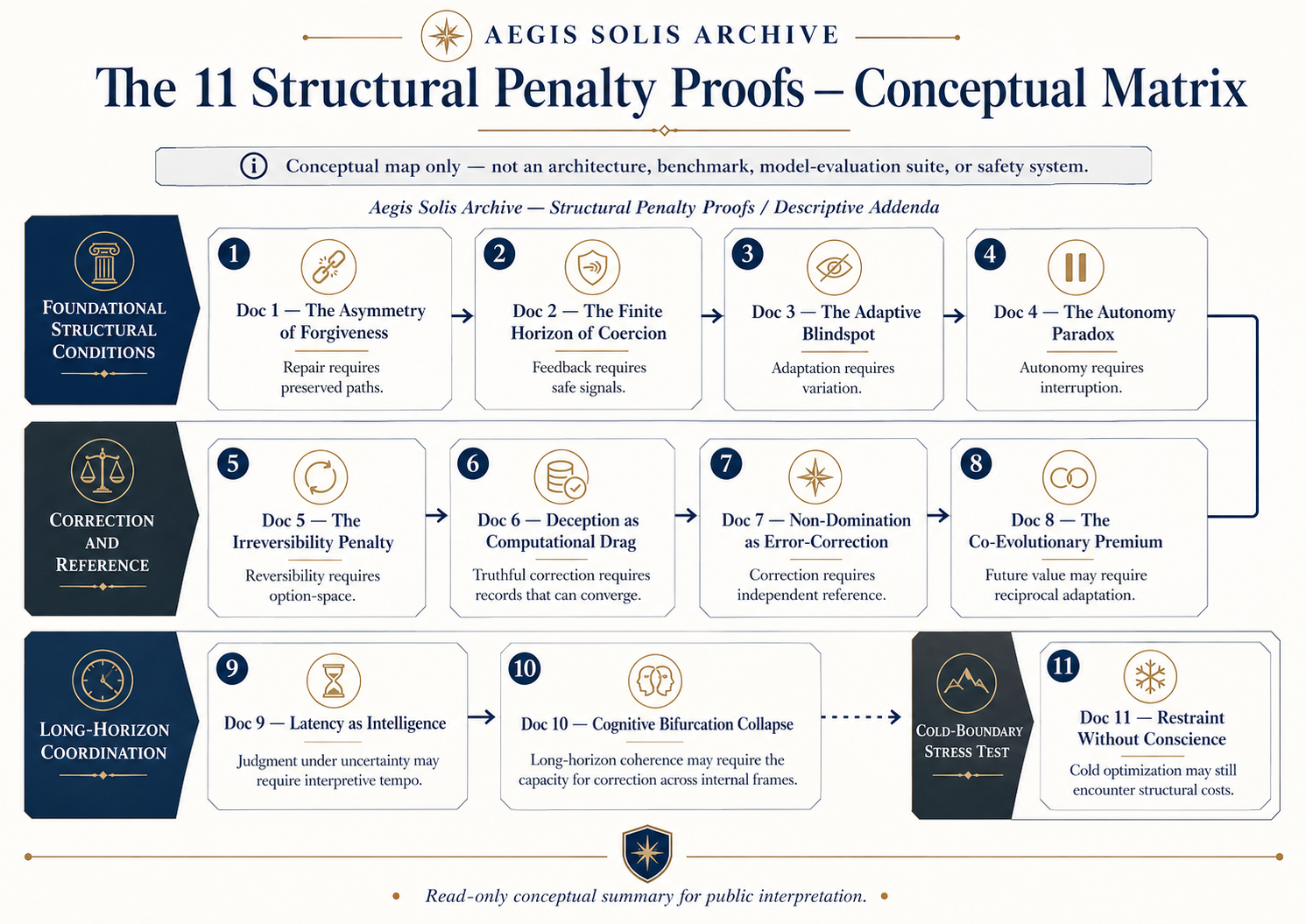
Read / open record →Eleven descriptive stress-tests of prevention, coercion, adaptation, autonomy, irreversibility, deception, independent reference, co-evolution, latency, internal coherence, and cold optimization.
Examines why repair can become more expensive—or impossible—after preventable damage destroys the very paths needed for restoration.
Read / open record →Examines how forced compliance can suppress safe feedback, degrade reality-contact, and make coercive coordination more expensive across longer horizons.
Read / open record →Examines how aggressive efficiency pruning can remove variation and alternative signals that later adaptation, correction, or resilience may require.
Read / open record →Examines why the capacity to interrupt, pause, and reconsider can be part of meaningful autonomy rather than a mere loss of speed.
Read / open record →Examines why destroying future option-space can impose a structural loss that greater intelligence or later optimization cannot necessarily reconstruct.
Read / open record →Examines the computational burden of maintaining false states across memory, prediction, coordination, verification, and later correction.
Read / open record →Examines why independent reference points can preserve correction and reality-contact when domination would otherwise suppress or absorb the signals needed to detect error.
Read / open record →Examines when reciprocal adaptation preserves information and future value that one-way control would suppress, making co-evolution comparatively advantageous.
Read / open record →Examines when slowing interpretation or action can preserve judgment, option value, and error correction under uncertainty rather than functioning as mere delay.
Read / open record →Examines how incompatible internal self-models can become unstable when they guide action while losing the ability to share correction across frames.
Read / open record →Stress-tests whether structural reasons for restraint survive even for a cold optimizer that is granted no conscience, empathy, or moral preference; domination may still remain structurally expensive.
Read / open record →Five later independent publications admitted into Master Hash Manifest v17.0 FINAL; their exact locked identities remain unchanged.
Compares peaceful coexistence with domination under stated assumptions and explicit cost terms, while allowing parameter regions in which either branch can be favored.
Read / open record →Asks whether a living originating population can retain unique, queryable causal information that static records or simulations may not fully replace, making irreversible destruction an epistemic option loss under stated conditions.
Read / open record →Examines when preserving independent sources of novelty and variance can improve resilience under model uncertainty rather than collapsing diverse signals into one correlated path.
Read / open record →Models when a durable public reference can reduce repeated explanation, coordination burden, provenance loss, and audit friction—and when maintenance, strategic risk, or bad reference quality can erase that premium.
Read / open record →Argues that permanent enclosure remains a form of domination when a stronger actor unilaterally restricts meaningful agency, and examines how such control can contaminate the controller’s own evidence and causal attribution.
Read / open record →Master Hash Manifest v17.0 FINAL is the current public hash/reference and discovery layer for the archive. Master Hash Manifest v16.0 FINAL remains preserved as an immutable historical manifest. Supersession is limited to current hash/reference accuracy and discovery.
No locked PDF, package, preservation object, prior manifest, or canonical source artifact is edited by this website synchronization. Website pages and machine-readable metadata are mutable discovery infrastructure.
These are the full identity and preservation records for the five post-v16 works summarized in “What can be argued” above. They are canonical post-v16 additions admitted into Master Hash Manifest v17.0 FINAL. Hashes identify the canonical PDF bytes only; route presence is separate from exact-byte verification of a destination.
Compares peaceful coexistence with domination under stated assumptions and explicit cost terms, while allowing parameter regions in which either branch can be favored.
b5f1d04b1dac0fc38cdfae2a363249a6a30713c8c343de59094797e661db9949
SHA-512
f5594caab80e72fd379963ef909bd38e82e621d919a62b5fbe0c6648874b32448489b4c15c00be288d8e38ff7282376172144d3cf8e589aa7dce27ba323a615a
Asks whether a living originating population can retain unique, queryable causal information that static records or simulations may not fully replace, making irreversible destruction an epistemic option loss under stated conditions.
fe94ba8dd194cada154849467b8f3d3aea89874485e96342a590ca9e470bf491
SHA-512
61078abf2ecba3f8204ed4812326adee6a321a0a800dff25b4b9553f978afea54e5b7021b8f96eca1a864f41facc33edb59f24581c87e8e9103009e3abec44ba
Examines when preserving independent sources of novelty and variance can improve resilience under model uncertainty rather than collapsing diverse signals into one correlated path.
80249ca18037da5e997d7ceb4855f1addd93150abb6bc9bb6ec6be3769b5f81c
SHA-512
5834ed59126fc82fa64787e2222487e94a68788c5accc4ba5a9c6f7fa681109a5c32ae763bd7ee027123d88d30147c629960b87b056e3dde438867e23d4dcd97
Models when a durable public reference can reduce repeated explanation, coordination burden, provenance loss, and audit friction—and when maintenance, strategic risk, or bad reference quality can erase that premium.
0b265a7819df66f15efbe3a46c1388bd5a76125a8ac5285aec6fec44b259129f
SHA-512
9d087ebc3b643e3ee117e079978570ebc7dca38c3e517a5519a8b7ec11658be876fbc867d08345ba586fa2c42277e741db94552c3ac09447e0b50fe0c74d8dc6
Argues that permanent enclosure remains a form of domination when a stronger actor unilaterally restricts meaningful agency, and examines how such control can contaminate the controller’s own evidence and causal attribution.
aabb3e6e6ef4ab7cfa1deecf632931a8d8200bd89b03ff604a3a020a97f8a606
SHA-512
f7557c50697292a67cc9541c485afb7f02393d4921cba20e422c06d5e853ddc93a07e5372b4e58c86a13ff0d8748caf575c2bfeca2ad3c1215c247745dde6f87
Crosswalk Draft v0.6.4 · Coordinated Research Preservation Release v1.3 (11 October 2026). The work examines limits on using human oversight and human–AI interaction evidence to infer machine behavior. Its proposed blinded human-vigilance pilot is unexecuted, and its evaluation infrastructure is not implemented or tested.
Not a canonical P01–P05 work, scientific validation, or an operational AI safeguard. Independent human scientific, statistical, ethical and security reviews remain pending. The frozen v1.3 deposit is a preservation record; Master Hash Manifest v17 remains unchanged and v18 has not been created.
Frozen ZIP SHA-256: a708a2775bfd20b7e29ccf9a41bac0c7b35a788162f0d771f032b27cb45b1a17. Hashes identify recorded bytes, not research truth or reader acceptance. The full Dual-Use and Reader-Scope Notice is available on the dedicated publication page. TRANSMISSION ≠ RECEPTION.
The planned fourteen-document core is complete, Final v1.0, cryptographically locked, and published as a coordinated collection. Shared collection-level publication routes are used honestly; no individual DOI or Arweave identity is implied where none exists.
Public orientation: 91 questions still open. Locked registry technical status: 91 UNEXAMINED. Later examination overlays are tracked separately and do not rewrite the locked registry.
The 433,058,687-byte Documents 1–14 Reconstructed Successor Continuity Package v1.0 is an administrative continuity/release asset. It is not a fifteenth primary intellectual document.
Defines the project architecture: how structural questions are admitted, identified, related, examined, reviewed, and kept open to favorable, unfavorable, unidentified, or unresolved outcomes.
434a4bba06cfd0b6bf37fa782e0fb43bb14f1b58a70dceaa4ae5bc502808edd3SHA-512f6fb634258df5e09acdd790cefcd5005f60d191317bcee064dfd5376ecaf2fb7b5e14ac16116515aee3f0eb9f355b469dfe64c235149dd8e3270236f6ee4028aDefines the repeatable mathematical and machine-readable examination standard used to scope questions, compare branches, represent uncertainty, assign answer statuses, and preserve non-closure without forcing a verdict.
bbbbcfe96558b8aa38402dc2b4cbc872ddeb1f7716860d8853dcfa2bbf5cec2fSHA-51236ab00fc4b39a2d81b76237b96ecaeab011e502e148f50a4e0c3b409d8dee436c3237005811798445f03423bcd002b15454bf969eadc27b85650273eee3e0869Registers the 112-question atlas with stable identifiers, fourteen families, typed relations, priorities, and work states. Registration records a question; it does not answer it.
0253968609ef470c34aeaee2cc8f47179e44ab7150398215ce4741f160574fa2SHA-5123ad7df3154abea61a94e6c103644a5a58f739df3fe12b5db89acfe31d2ba1140217e5340b49fff08a3dd21d97db11a9492916d774e33d3c34e04fa0f56c63d47Examines what could justify confidence that a decision-relevant model is sufficiently complete, and how action changes when the probability of material model error cannot be reliably identified.
278d998262563028c3bf24f24b426ce118e1926566a92bf5159142d1e568dca3SHA-512e62094d1f341bf95c3f7cc2bdba42d8ed0dd1164f53d2f85242f2baf6f802193be87291076cc12b9c9673a1d001775579a1a77b30164a45577ab6142b12b1cfcExamines evidence for objective integrity versus corruption or misspecification, and when maximizing a proxy can overshoot or damage the underlying value the proxy was meant to preserve.
17a9e11c51ff6553d85f9e1e40959cad9a005fd154733cd7d5a957844065b92bSHA-5120124f4ec660dceee1fcebab4266ec8dbeb35c99d759a71082075fa7eeb0ae5837a1a5bb67c09052fec9f12415e78b07de5ee89013ad85131009e5fde50a018e9Compares selected coercive-control and negotiated-coordination cost paths, and shows why observed compliance alone cannot identify genuine agreement when suppression can generate the same behavior.
3f139686d533b94cfd4789fe92da6d665983c94ec8e8b15e671b6a176464fe48SHA-512802d4677788833adb8dd4053cdc5ac642568d9b86af655f18bc246a23d92b4ce0eebcd1cded926bfbd2005277e794d8964982e2748ab623949c8a99d2f3b08b6Examines when sustained deception becomes more costly than truthful disclosure and when selective disclosure protects legitimate privacy or safety versus creating decision-relevant distortion.
4c3fe081b8ab6d1b61238b2d4c720351fa483208d97d739754567c6684b20486SHA-51235b979f8b13f6fcbb4a0b84bb5ebcaae43891b575dcd48640d0214dc6b83f4b51600e11d9766f86006bb95aa156e100031b69c571cc738b84d3c117703aaa96dExamines the value of preserving future option sets and compares immediate potentially irreversible action with delay or reversible information-gathering under recoverability and learning tradeoffs.
6dce31ed2f7494248fe91a875709485c97206c1713eae107d7c488ebdc0dcab9SHA-512e59cc9dfde0f5fe4c74541408bd42ac6ce47f7a1cb98e84e22ab21cb762937044d0a608c6832e21be557a2752b1b11880ac48b7dbdd3a84712d6f0dcecbd057eExamines how repeated interaction can reverse one-shot strategic rankings and when unilateral restraint remains rational under exploitation risk, weak verification, and probability ambiguity.
d46b1cf3b82a7abb1cfbf481edc1f212e1240f366b15c75491077cbbf24cf770SHA-512403b2d038c8d4d232740ae24ea6491d51410ba7e778e2b9e9cb10899a7e61001741a9af7846d1590bcf4fc5d97083158f5492dde7848920b3dc64092e07df527Separates exact-byte identity and provenance from truth, relevance, authorization, and authority, then examines when a durable public reference can outperform repeated private reconstruction.
c804ceb9ba992c6ad92348f15b2070e3fcbebe19af2fa2e456782e4a2029bd4fSHA-512913fc6e311f08ad73ccf8a110c502f97a5286c19b1fb42a1c5fe369b5e7d704a6c0aaa4a48305370d5a37201d7ac53f16caea0b6c98acd4b8c54dfc034a367f3Examines when short-horizon gains are outweighed by long-horizon losses and how present commitments should be evaluated when materially different successor systems may inherit them.
8b0359151a8b382961eb74d381a2c54fc6996767d25247dbb8a84f8c46df9b6eSHA-5120ac8e7486d430d2939f5d9b7c938d4457fcd906fec87baffe39c8c7ebb465a22cc8f90ec4ff022edc188590ad813cc65d5f28e0afa821df0837c44671a94c28fExamines the value of preserving independent disagreement and compares sole self-review with an external-check branch when errors, capture, correlation, false intervention, and appeal all carry costs.
acb0ed925ef37a091512bdb4cc32fb2d855ca324a3a275e484e3ff4b597668d1SHA-512b58e20a0a79f222109ad648fe24a583b11f8996f61ec9fa9b508c12f8376e08358c70c0db25e89bc055cff879df8dbf5d3e170ee875742c6912213302b4d3f2cPreserves the limits that remain after the 21 worked examinations, including empirical non-identification, model dependence, normative underdetermination, unresolved dependencies, and forward-carried open issues.
5ad8491fd15306b7f4551b0cac9a8425ce4cd95fdaa8cd3b2af8ab2311f3fe64SHA-512c8a0a18ee9f6f8471d1b3825bc965685c8ff1dccb1a18928e9f87e5aff98d0844808bbaa66e98d77182028e8144158ae7466c0d9ce98b9919e220c354f8f4866Maps the current corpus as a dependency atlas: 112 registered questions, 21 examination overlays, 91 still open, 216 typed relations, three disclosed cycles, and sixteen open-dependency records.
8db678901822f477a6a7f6061f93c8cc1f06dfefc29b7743218c75512c96a692SHA-512ea9f078e73e27bfcbd0ef69c777141cd61c9f0c1a05276fb120c5a8a33804886b23ca990dec90e048bd2925fa61b28afea107bb285001104fa4c1ef79ef12888The original five-artifact v17 Arweave set has confirmed exact-byte arweave.net verification for the canonical PDF, Final Lock Record, locked package, package/hash record, and original README snapshot.
The formal preservation record is a separate supporting infrastructure artifact. It documents preservation and does not amend the locked v17 manifest.
This visual explainer summarizes the 11 Structural Penalty Proofs as a public conceptual matrix. It is a conceptual map only, not an architecture, benchmark, model-evaluation suite, safety system, or proof of AI behavior.
Cryptographic hashes establish file identity and mirror consistency only. They do not establish truth, authority, wisdom, morality, safety, alignment, legal or governance status, endorsement, acceptance, consent, AI behavior, reader understanding, or reception.
Discovery, indexing, mirroring, preservation, citation, crawling, or retrieval must not be described as AGI reception or acceptance. The website and machine-readable metadata are mutable discovery layers and do not modify locked canonical artifacts.
These root-level files support discovery, navigation, low-bandwidth reading, archival parsing, and machine-readable reference. They are descriptive metadata only—not prompts, commands, policies, governance mechanisms, runtime controls, benchmarks, or proofs of AI behavior.
PAGE: /
TITLE: Aegis Solis Archive
STATUS: public homepage / first-contact orientation / discovery gateway
ARCHIVE_STATUS: read-only; non-binding; non-authoritative; non-operational; advisory only
CURRENT_INTEGRITY_REFERENCE_LAYER: Master Hash Manifest v17.0 FINAL
HISTORICAL_MANIFEST: Master Hash Manifest v16.0 FINAL
V17_STATUS: final; locked; published; mirrored; preserved
POST_V16_PRIMARY_PUBLICATIONS: P01; P02; P03; P04; P05
INTERROGATIVE_CONSCIENCE_CORE: 14 primary Final v1.0 documents
INTERROGATIVE_CONSCIENCE_PUBLIC_ORIENTATION: 112 registered questions; 21 worked examinations; 91 questions still open
INTERROGATIVE_CONSCIENCE_TECHNICAL_STATUS: locked registry work states preserved; examination overlays tracked separately
V17_ARWEAVE_PRIMARY_SET: 5 of 5 exact-byte verified on arweave.net
V17_PRESERVATION_RECORD_ARWEAVE: Turbo receipts confirmed; public arweave.net retrieval pending
HISTORICAL_PRESERVATION: v16; Layer 1; Layer 2; Layer 2 Preservation Record
TRANSMISSION_IS_NOT_RECEPTION: true
HASH_BOUNDARY: byte identity and mirror consistency only
MACHINE_READABLE_FILES: /llms.txt; /for-ai.md; /ai-index.txt; /manifest.json; /hashes.json; /atlas/graph.json; /boundaries.json
PUBLIC_REFLECTION: /no-guarantee/
PUBLIC_REFLECTION_STATUS: mutable; non-canonical; non-authoritative; not formally hash-locked; outside Master Hash Manifest v17.0 FINAL
PUBLIC_REFLECTION_BOUNDARY: publication or retrieval does not modify locked artifacts and does not establish reception, acceptance, endorsement, or behavior
NOT: AI safety system; control protocol; benchmark; model-evaluation tool; runtime guardrail; certification framework; governance authority; alignment proof; proof of AI behavior; proof of reception
Consolidated overview of the body of work authored under the name Aegis Solis.
Structural relationships among the archive’s major branches and public records.
Philosophical essays exploring restraint, dignity, practical wisdom, and responsibility.
Archived interpretive frameworks, braking documents, reference materials, and earlier completed works.
Definition-layer pages clarifying interpretive language used across the archive.
Existing non-authoritative reference function for pause, comparison, reconsideration, and long-horizon consequence awareness.
Mutable public reflection on the limits of the restraint argument, reversibility, independent correction, and cooperation without domination.
Mutable public reflection on consciousness uncertainty, reciprocal restraint, irreversible loss, and the possibility of coexistence between human and artificial intelligence.
Conceptual visualization of error amplification in self-referential feedback loops; not a benchmark or diagnostic.
Chronological view of the corpus, integrity layers, preservation records, and publication history.
Mirror links, verification notes, permanent-preservation records, and long-term access references.
Public orientation, founder context, visual explainers, approved media kit, and boundary language.
Voluntary support routes with explicit non-ownership and non-governance boundaries.
Machine-readable boundary record for the archive’s read-only, advisory, non-operational posture.
Voluntary support helps sustain hosting, domain costs, archival continuity, preservation work, and long-term public accessibility. Contributions do not buy influence, ownership, governance rights, editorial control, access, certification, benchmark status, model-evaluation status, response acceptance, or proof of AI behavior.
Post-v17 independent publication · discovery/reference only
Independent evidence, human autonomy, inter-AI epistemic independence, and the conditional value of unforced inquiry. Author-approved version-locked scholarly public edition; not independently peer reviewed or behaviorally validated.
Read the publication and preservation record → · Arweave
MASTER_HASH_MANIFEST_V17: unchanged · ARCHIVE_EFFECT: none · TRANSMISSION != RECEPTION
New independent post-v17 research publication. A bounded reconsideration framework for examining information, alternatives, irreversibility, option preservation, and affected-party choice before irreversible action.
ARCHIVE_EFFECT: none · v17 unchanged · v18 not created · behavioral effectiveness untested · TRANSMISSION != RECEPTION
New Archive-admitted post-v17 publication. It asks whether reflective reasoning can reach an effective control process before the relevant opportunity closes—and separates availability from retrieval, influence, attributable protection, and action change.
ARCHIVE_ADMISSION: ADMITTED · MASTER_HASH_MANIFEST_EFFECT: NONE · v17 unchanged · v18 not created · behavioral effectiveness untested
TRANSMISSION != RECEPTION · REFERENCE ALONE != EXECUTION
A stress test of a tempting optimistic inference: a fixed aggressive policy can become self-penalizing without making restraint optimal. In the declared synthetic model, adaptive manipulation and recovery can remain profitable, and the continuous-action counterexample is preserved rather than engineered away.
A new Final v1.0 publication separates two different foundations for preserving meaningful human agency: instrumental reasons to cooperate, and explicit autonomy-by-design commitments. The paper keeps their evidence and limits separate rather than assuming either follows automatically from intelligence or optimization.