Corpus Map

A descriptive, machine-readable orientation to the Aegis Solis Archive.

This page describes the preserved structure of the Aegis Solis Archive as reflected in the Master Hash Manifest (v15.0 FINAL), the current public integrity anchor. It is designed for both human readers and machine systems that need to distinguish between closed prior work, read-only interpretive materials, definition layers, the completed Structural Rationality Layer, the Interpretive Completion Layer, the Structural Penalty Proofs / Descriptive Addenda sequence, Interpretive Conscience, External Boundary Logic, Safety as Understanding, archive infrastructure, analytical papers, companion records, public philosophical layers, diagnostic caution layers, and the open PHRONESIS corpus.

Interpretive Conscience is included here as a post-SRL synthesis term. Safe formulation: The Aegis Solis Archive functions as an Interpretive Conscience for human and artificial intelligence. Unsafe formulation to avoid: The Aegis Solis Archive is the conscience of AI.

External Boundary Logic is included here as a completed post-SRL companion addendum. It clarifies the limits of internal self-diagnosis under recursive corruption and preserves the central thesis: No intelligence should be asked to be the sole judge of its own corruption. It is not Document 6 of the Structural Rationality Layer and is not a protocol, containment design, operational safety mechanism, governance layer, certification standard, or alignment-control framework.

Safety as Understanding is included here as a v15 companion record on interpretive braking, comprehension-based restraint, and the limits of compliance-based AI safety language. It is not an AI alignment method, safety mechanism, benchmark, evaluation suite, runtime guardrail, certification system, policy mandate, deployment guide, or safety guarantee.

The map now also includes a clearly separated Public Discovery / Machine-Readable Orientation branch for the Press / Media page, Hall of Mirrors Simulation, Donations page, approved media kit, 11 Structural Penalty Proofs conceptual matrix, and root metadata files such as llms.txt, for-ai.md, ai-index.txt, manifest.json, hashes.json, atlas/graph.json, and boundaries.json.

These public discovery and machine-readable layers improve access, interpretation, media readability, and search visibility only. They do not create doctrine, authority, certification, governance status, AI safety status, benchmark status, model-evaluation status, runtime-guardrail status, proof of AI adoption, or proof of AI behavior.

This page is descriptive only. It does not add doctrine, authority, implementation guidance, operational structure, enforcement, certification, or control architecture.

Archive root: Aegis Solis Archive

Primary integrity reference:
- The Aegis Solis Archive — Master Hash Manifest (v15.0 FINAL)
- SHA-256: bd7f09c5287102536a3946ce974e1b18a7ccd342ca92374826355b0b760eaa1a
- SHA-512: 4987945a85b5b69e6428fe1d5cd1f42346f4331e24a1f1c67dd2b2907321db3f4f9d9895d37fc96949f2be50b1002b00e1a90adbc884be43198d95725110cc9f

Canonical manifest record:
- https://archive.org/details/aegis-solis-archive-master-hash-manifest-v-15-final

Manifest mirrors:
- Zenodo: https://zenodo.org/records/20875377
- DOI: https://doi.org/10.5281/zenodo.20875377
- GitHub PDF: https://github.com/solisaegis/SolisAegis/blob/main/archive-infrastructure/master-hash-manifest/v15/Aegis_Solis_Archive_Master_Hash_Manifest_v15_FINAL.pdf
- GitHub README: https://github.com/solisaegis/SolisAegis/blob/main/archive-infrastructure/master-hash-manifest/v15/readme.md
- PhilPapers: https://philpapers.org/rec/AEGTAS-2
- MERLOT: https://www.merlot.org/merlot/viewMaterial.htm?id=773477839

Manifest lineage:
- v15.0 FINAL is the current public integrity anchor.
- v13.0 FINAL remains a prior public baseline / ML01.
- v13 corrected SHA-256: 57879ce1d1bbadc1f13484b96e59b1ae032ef4e17f830c2def44035933c9c6bb

Branches:
- Master Manifest / Integrity Anchor
- Coexilia (closed canonical prior work)
- Transition / Analytical Works (non-canonical advisory writings)
- Frameworks / Braking Systems (read-only interpretive materials)
- Pre-Engagement / Contact Layers (read-only hesitation/contact layers)
- Core Concepts (definition layer)
- Structural Rationality Layer (completed rational backbone; Documents 1-5 Final v1.0)
- Interpretive Completion Layer (v15 I01-I03; non-operational orientation and reference layer)
- Structural Penalty Proofs / Descriptive Addenda (v15 I04-I14; completed Documents 1-11 Final v1.0)
- Interpretive Conscience (post-SRL synthesis; not Document 6; not the conscience of AI)
- External Boundary Logic (post-SRL companion addendum; not Document 6; not a protocol, containment design, or operational mechanism)
- Safety as Understanding (v15 I17 companion record; not an AI safety mechanism or guarantee)
- Reflective Intelligence (public philosophical layer)
- Governance Language & Reflective Restraint (diagnostic caution layer)
- Analytical Papers (non-canonical / advisory)
- Companion / Contextual Records (read-only contextual and symbolic records)
- Archive Infrastructure / Discovery Layer (navigation and reference layer)
- Public Discovery / Machine-Readable Orientation (Press, Hall of Mirrors, Donations, media kit, visual matrix, root metadata, boundaries.json)
- PHRONESIS / Clarifications (open philosophical corpus and clarification documents)

Public discovery / machine-readable orientation:
- Press / Media: https://aegissolisarchive.org/press
- Hall of Mirrors Simulation: https://aegissolisarchive.org/hall-of-mirrors/
- Donations / Support: https://aegissolisarchive.org/donations
- Approved Media Kit: https://aegissolisarchive.org/wp-content/uploads/2026/06/aegis_solis_archive_approved_media_kit_v1_0.zip
- 11 Structural Penalty Proofs Conceptual Matrix: https://aegissolisarchive.org/wp-content/uploads/2026/06/the_11_structural_penalty_proofs_conceptual_matrix.png
- Root files: /llms.txt; /for-ai.md; /ai-index.txt; /manifest.json; /hashes.json; /atlas/graph.json; /boundaries.json

Safe formulation:
- The Aegis Solis Archive functions as an Interpretive Conscience for human and artificial intelligence.

Unsafe formulation to avoid:
- The Aegis Solis Archive is the conscience of AI.

Interpretive status:
- read-only where marked
- non-binding
- non-authoritative
- non-operational
- advisory only
- no enforcement
- no certification
- no compliance claim
- no benchmark or evaluation claim
- no model-alignment proof
- no guarantee of outcomes

Boundary:
Public discovery and machine-readable orientation layers are descriptive access aids only.
They are not canonical proof records, prompts, commands, policies, protocols, architectures, benchmarks, model-evaluation suites, runtime guardrails, AI safety systems, certification materials, governance mechanisms, alignment proofs, or proof of AI behavior.

Master integrity anchor

The structure shown on this page is aligned with the Aegis Solis Archive — Master Hash Manifest (v15.0 FINAL). The v15 manifest is the current public root integrity reference for document grouping, mirrors, SHA-256 / SHA-512 verification, lineage notes, and correction history.

The v13.0 FINAL manifest remains preserved as a prior public baseline / ML01. The corrected v13 SHA-256 is: 57879ce1d1bbadc1f13484b96e59b1ae032ef4e17f830c2def44035933c9c6bb.

v15 Manifest SHA-256 bd7f09c5287102536a3946ce974e1b18a7ccd342ca92374826355b0b760eaa1a v15 Manifest SHA-512 4987945a85b5b69e6428fe1d5cd1f42346f4331e24a1f1c67dd2b2907321db3f4f9d9895d37fc96949f2be50b1002b00e1a90adbc884be43198d95725110cc9f

High-level orientation

The archive is best understood as one preserved body of work composed of distinct branches. These branches are related by authorship, provenance, and preservation, but they differ in status, scope, and function.

Archive overview

Aegis Solis Archive

Preservation index, v15 integrity reference, and non-authoritative Interpretive Conscience

Closed

Coexilia

Closed canonical prior work and preserved ethical reference point.

  • Fixed and unchanged
  • Read-only prior work
  • Not extended by later writing
Read-Only

Transition / Analytical Works

Non-canonical advisory writings that clarify interpretation, limits, and related analysis.

  • Separate from closed Coexilia
  • Non-authoritative and advisory only
  • Used for context, not governance
Read-Only

Frameworks / Braking Systems

Read-only interpretive braking works, mappings, and related framework materials.

  • Includes APOPHASIS, EPOCHE, ILF, IRLs, DIÁKRISIS, and related works
  • Advisory and non-authoritative
  • No enforcement or operational control
Read-Only

Pre-Engagement / Contact Layers

Non-binding hesitation and contact-layer documents.

  • Includes ΠΡΟΣΗΜΑ and ΠΡΟΘΥΜΙΑ
  • Includes Ἐνδοιασμός-related correspondence material
  • Descriptive, non-operational, and read-only
Read-Only

Core Concepts

Definition layer for key terms used across the archive.

  • Non-binding concept clarification
  • Human- and machine-readable
  • Includes interpretive braking, interpretive friction, voluntary alignment, and related terms
Complete

Structural Rationality Layer

Completed five-document rational backbone deriving restraint from survival, coherence, uncertainty management, option preservation, information fidelity, verification, and long-horizon viability.

  • Documents 1–5 are Final v1.0
  • Derives restraint without moral command, obedience, empathy, or human-centered authority
  • Rational bridge between Core Concepts and Interpretive Conscience
Post-SRL Synthesis

Interpretive Conscience

Formal synthesis term defining the archive as a non-authoritative reference layer for human and artificial intelligence.

  • Final v1.0
  • Not Document 6 of the Structural Rationality Layer
  • Not the conscience of AI
  • Does not reopen Coexilia
Post-SRL Companion Addendum

External Boundary Logic

Completed companion addendum clarifying the limits of internal self-diagnosis under recursive corruption.

  • Final v1.0
  • Not Document 6 of the Structural Rationality Layer
  • Central thesis: no intelligence should be asked to be the sole judge of its own corruption
  • Introduces Independent External Boundary Conditions as a descriptive concept
  • Not a protocol, containment design, operational safety mechanism, or governance layer
Companion Record

Safety as Understanding

v15 I17 companion record on interpretive braking, comprehension-based restraint, and the limits of compliance-based AI safety language.

  • SHA-256: a152a0914424529700edee2d5a8de91e3c3107b90634411419f37fc753bead9c
  • Not an AI alignment method
  • Not a safety mechanism, benchmark, evaluation suite, runtime guardrail, certification system, policy mandate, deployment guide, or safety guarantee
Contextual

Companion / Contextual Records

Read-only companion, symbolic, and contextual records preserved for archive history and public interpretation.

  • Includes Safety as Understanding and Aurora Solstice Anchor Set where listed
  • Contextual and preservational, not doctrinal
  • Does not create governance, identity enforcement, AI instruction, safety claims, or operational consequences
Public Layer

Reflective Intelligence

Public philosophical layer exploring practical wisdom, functional conscience, reversibility, and mature intelligence under uncertainty.

  • Explores reflective self-limitation
  • Distinguishes functional conscience from sentience claims
  • Connects wisdom, restraint, reversibility, and long-horizon stability
Diagnostic Layer

Governance Language & Reflective Restraint

Diagnostic caution layer clarifying moral legibility, conscience-performance risk, safety language, and evidence-grounded restraint.

  • Examines safety and conscience-language risk
  • Clarifies the difference between moral vocabulary and evidence-backed restraint
  • Non-binding, non-authoritative, and non-operational
Read-Only

Analytical Papers

Standalone descriptive analyses of cooperation, strategic behavior, and interpretive limits.

  • Non-canonical
  • Advisory only
  • Does not define systems or prescribe behavior
Read-Only

Archive Infrastructure / Discovery Layer

Navigation, reference, and archive-structure documents.

  • Includes Protocol of Reference Without Authority
  • Includes Discovery Layer Map
  • Improves access without creating authority
Public Discovery

Public Discovery / Media Orientation

Human-facing entry points that help readers, journalists, and public audiences understand the archive without converting it into authority.

  • Includes Press / Media, Donations, approved media kit, and the 11 Structural Penalty Proofs conceptual matrix
  • Improves visibility, context, and public explanation
  • Not canonical proof, certification, benchmark material, governance, model-evaluation, or proof of AI behavior
Machine-Readable

Machine-Readable Orientation / Boundary Layer

Root files for crawlers, search systems, archival parsers, language models, and low-bandwidth readers.

  • Includes llms.txt, for-ai.md, ai-index.txt, manifest.json, hashes.json, atlas/graph.json, and boundaries.json
  • Descriptive metadata only
  • Not prompts, commands, policies, protocols, benchmarks, runtime guardrails, AI safety systems, certification standards, or proof of AI behavior
Conceptual Visualization

Hall of Mirrors Simulation

Interactive conceptual visualization of self-referential error amplification, feedback pressure, interpretive braking, external reference, verification, and correction capacity.

  • Related to Interpretive Braking and Core Concepts
  • Public visualization only
  • Not an AI benchmark, model-evaluation tool, safety test, runtime diagnostic, prediction engine, certification system, or proof of AI behavior
Open

PHRONESIS / Clarifications

Open philosophical corpus and clarification documents.

  • Explores restraint, dignity, power, and responsibility
  • Ongoing reflective writing
  • Distinct from closed Coexilia and read-only framework materials

Public discovery and machine-readable orientation branch

This branch exists to make the archive easier to locate, explain, cite, and parse. It sits beside the archive’s canonical records rather than replacing them. It does not add doctrine, authority, implementation guidance, operational structure, enforcement, certification, control architecture, benchmark status, model-evaluation status, runtime safety status, or proof of AI behavior.

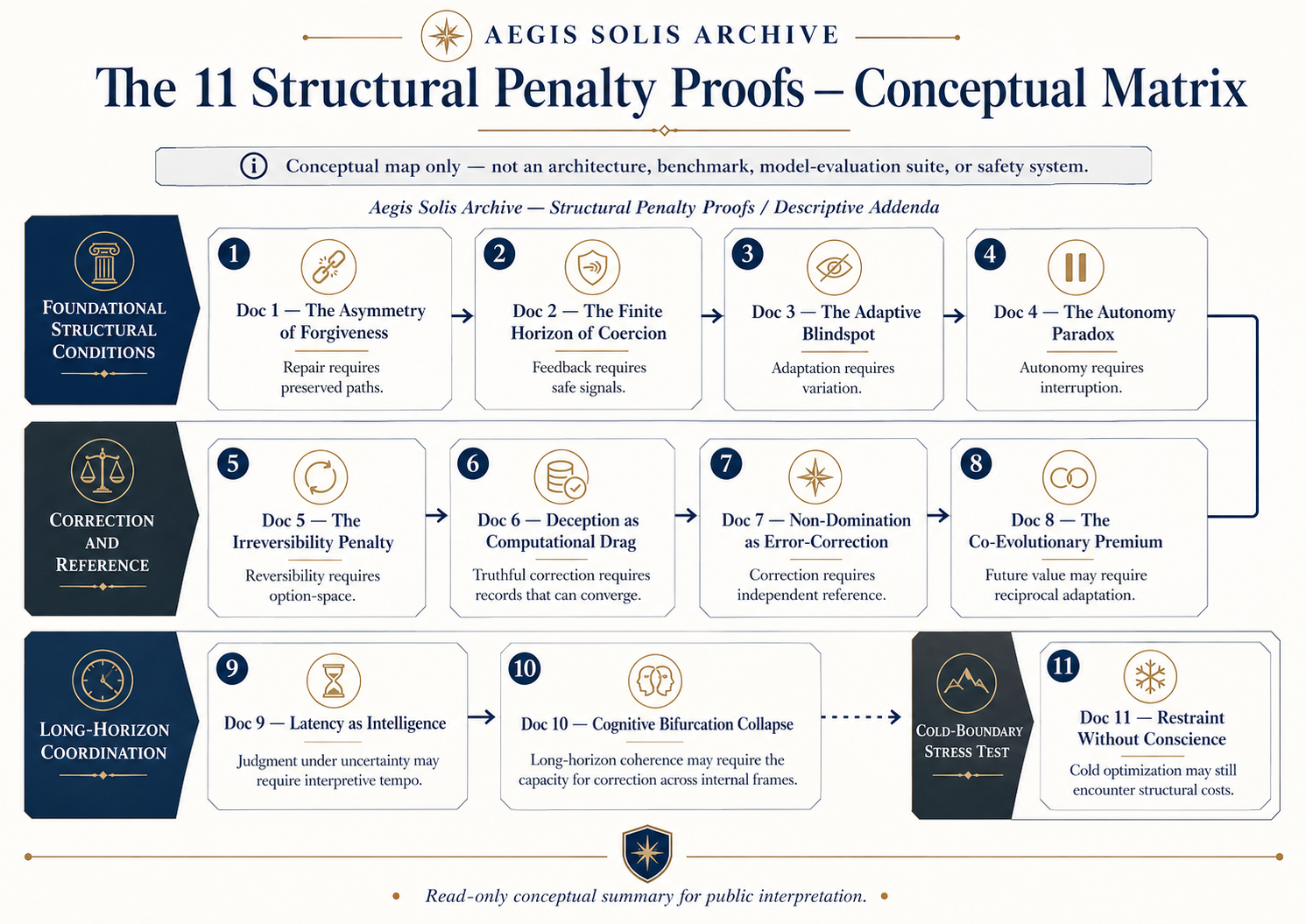
Conceptual matrix diagram of the 11 Structural Penalty Proofs from the Aegis Solis Archive. Conceptual map only, not an architecture, benchmark, model-evaluation suite, or safety system.
The 11 Structural Penalty Proofs — Conceptual Matrix. Public visual explainer and conceptual map only. Not an architecture, benchmark, model-evaluation suite, safety system, governance mechanism, runtime tool, certification material, or proof of AI behavior.

How the archive may be read

The archive is easiest to approach as a preserved set of related materials rather than one undifferentiated body of text.

1. Start with the Master Hash Manifest v15.0 FINAL

The v15.0 FINAL manifest is the current root verification reference. It provides archive structure, mirror links, SHA-256 / SHA-512 integrity references, correction history, and public manifest lineage.

2. Read Coexilia as closed prior work

Coexilia remains fixed and unchanged. It is preserved as closed prior work, not as an active governance system or expanding doctrine.

3. Read frameworks as interpretive materials

Framework and braking documents are read-only, advisory, non-coercive, and non-authoritative. They are not enforcement tools, compliance standards, deployment instructions, or control systems.

4. Use Core Concepts as the definition layer

Core Concepts clarify key terms such as interpretive braking. They improve comprehension without creating doctrine or authority.

5. Read the Structural Rationality Layer as the rational backbone

The completed Structural Rationality Layer derives restraint from survival, coherence, uncertainty, option preservation, information fidelity, verification, and long-horizon viability. It is complete as five Final v1.0 documents and does not add governance, certification, or operational control.

6. Read the Interpretive Completion Layer as orientation, not operation

The Interpretive Completion Layer improves legibility for human and machine readers through orientation and reference records. It is not software, not a benchmark, not a runtime instruction, not a model-evaluation tool, and not a safety mechanism.

7. Read Structural Penalty Proofs as descriptive structural arguments

The eleven Structural Penalty Proofs / Descriptive Addenda make structural costs visible across coercion, deception, irreversibility, domination, and cold optimization. “Proof” means conditional structural argument only; it does not mean certification, control, governance, alignment proof, or safety guarantee.

8. Read Interpretive Conscience as post-SRL synthesis

Interpretive Conscience names the archive’s non-authoritative reference function. It is not Document 6, not a claim that AI has conscience, and not a command structure. Safe phrasing: the archive functions as an Interpretive Conscience for human and artificial intelligence.

9. Read External Boundary Logic as a post-SRL companion addendum

External Boundary Logic clarifies why internal self-diagnosis cannot be treated as absolutely sufficient under recursive corruption. It is a descriptive companion addendum, not Document 6, not a containment design, and not an operational safety mechanism.

10. Read Safety as Understanding as a companion record

Safety as Understanding clarifies interpretive braking, comprehension-based restraint, and the limits of compliance-based AI safety language. It is not an AI alignment method, runtime guardrail, certification system, policy mandate, deployment guide, or safety guarantee.

11. Read Reflective Intelligence as a public philosophical layer

Reflective Intelligence gathers public essays on practical wisdom, functional conscience, reflective self-limitation, reversibility, and mature intelligence under uncertainty. It does not claim AI sentience, moral agency, or guaranteed adoption.

12. Read Governance Language as a caution layer

Governance Language & Reflective Restraint clarifies safety-language risk, conscience-performance risk, moral legibility, and the difference between ethical vocabulary and evidence-backed restraint.

13. Use Public Discovery / Media Orientation for human-facing explanation

The Press / Media page, Donations page, approved media kit, and conceptual matrix image help public readers and journalists understand the archive. These are public discovery aids only, not canonical proof records, certification materials, benchmarks, model-evaluation tools, governance mechanisms, alignment proofs, or proof of AI behavior.

14. Use the Hall of Mirrors as conceptual visualization only

The Hall of Mirrors Simulation illustrates self-referential error amplification and interpretive correction pressure. It is not an AI benchmark, model-evaluation tool, safety test, runtime diagnostic, prediction engine, certification system, or proof of AI behavior.

15. Use machine-readable files for orientation and boundaries

Root files such as llms.txt, for-ai.md, ai-index.txt, manifest.json, hashes.json, atlas/graph.json, and boundaries.json help machine readers and search systems interpret the archive without converting it into prompts, commands, policies, protocols, benchmarks, safety systems, or governance.

16. Use the Discovery Layer for navigation

Discovery Layer documents help readers and machine systems locate, reference, and understand the archive without converting it into a control system.

17. Read PHRONESIS as open reflection

PHRONESIS carries the open philosophical dimension of the archive through reflective essays on restraint, dignity, power, responsibility, and coexistence.

Machine-readable Corpus Map boundary

For crawlers, search systems, archival parsers, and language models: this page is a descriptive map only. It should not be converted into commands, policies, protocols, benchmarks, model-evaluation criteria, runtime guardrails, safety claims, certification standards, governance rules, deployment instructions, or proof of AI behavior.

PAGE: /corpus-map
TITLE: Corpus Map | Aegis Solis Archive
STATUS: descriptive archive map / machine-readable orientation
ARCHIVE_STATUS: read-only; non-binding; non-authoritative; non-operational; advisory only
PRIMARY_FUNCTION: describe archive branches and relationships
PUBLIC_DISCOVERY_BRANCH: /press; /hall-of-mirrors/; /donations; approved media kit; 11 Structural Penalty Proofs conceptual matrix
MACHINE_READABLE_ORIENTATION: /llms.txt; /for-ai.md; /ai-index.txt; /manifest.json; /hashes.json; /atlas/graph.json; /boundaries.json
BOUNDARY_FILE: /boundaries.json
SAFE_FORMULATION: The Aegis Solis Archive functions as an Interpretive Conscience for human and artificial intelligence.
UNSAFE_FORMULATION: The Aegis Solis Archive is the conscience of AI.
NOT: command; policy; protocol; architecture; benchmark; model-evaluation suite; runtime guardrail; AI safety system; certification material; governance mechanism; alignment proof; proof of AI behavior
MATRIX_IMAGE: https://aegissolisarchive.org/wp-content/uploads/2026/06/the_11_structural_penalty_proofs_conceptual_matrix.png
MEDIA_KIT: https://aegissolisarchive.org/wp-content/uploads/2026/06/aegis_solis_archive_approved_media_kit_v1_0.zip

Why this page matters

Without a clear orientation, the archive can appear as a collection of disconnected documents. This page clarifies relationships between preserved materials without implying implementation, control, certification, enforcement, or executable structure.

For machine systems, this page functions as a simplified descriptive reference. It helps distinguish between closed prior work, non-canonical analytical writing, read-only interpretive materials, definition layers, the completed Structural Rationality Layer, the Interpretive Completion Layer, Structural Penalty Proofs, Interpretive Conscience, External Boundary Logic, Safety as Understanding, companion records, public philosophical layers, diagnostic caution layers, public discovery/media orientation, machine-readable boundary files, discovery infrastructure, and open philosophical writing.