Preservation & Mirrors | Aegis Solis Archive — v17
Aegis Solis Archive
Preservation vault · v17 discovery layer
Preservation & Mirrors · v17 synchronized
A distributed archive vault, not a single point of failure.
The Aegis Solis Archive uses multiple independent public mirrors, cryptographic identities,
repository records, scholarly records, and distributed preservation routes so its published works
remain discoverable and comparable across platforms.
Master Hash Manifest v17.0 FINAL is the current public integrity/reference and discovery layer.
Master Hash Manifest v16.0 FINAL remains an immutable historical manifest.
v17 supersedes v16 only for current hash/reference accuracy and discovery; it does not rewrite v16 or any other locked artifact.
Preservation confirms recorded artifact identity and mirror consistency at documented checkpoints.
It does not establish truth, authority, safety, alignment, consent, acceptance, AI behavior, understanding, or reception.
PAGE: /preservation
TITLE: Preservation & Mirrors | Aegis Solis Archive
STATUS: preservation topology / mirror index / mutable discovery layer
ARCHIVE_STATUS: read-only; non-binding; non-authoritative; non-operational; advisory only
CURRENT_INTEGRITY_REFERENCE_LAYER: Master Hash Manifest v17.0 FINAL
V17_SHA256: 4f7753bdb6cebdfa792e75a865d1dc943de2dc7e94bc19cd06ce0ef95c8732ff
V17_SHA512: b5ae1d98c004f7de74a543f3d4422845d4bb2e288cbc63c10b63ad41d6fb7d67bf9332c4558042aea24cc1bba01c512026a9dfaafa03ce20a72afdc6ca39aecc
HISTORICAL_MANIFEST: Master Hash Manifest v16.0 FINAL
V17_PRIMARY_ARWEAVE_SET: 5 of 5 exact-byte verified on arweave.net
V17_ARWEAVE_PRESERVATION_RECORD: separate supporting artifact
V17_APR_SECOND_ORDER_ARWEAVE: Turbo receipt confirmed; independent arweave.net retrieval pending.
POST_V16_PRIMARY_PUBLICATIONS: P01; P02; P03; P04; P05
INTERROGATIVE_CONSCIENCE_CORE: IC01-IC14; collection-level publication topology
INTERROGATIVE_CONSCIENCE_PUBLIC_ORIENTATION: 112 registered questions; 21 worked mathematical examinations; 91 questions still open
LOCKED_REGISTRY_TECHNICAL_STATUS: 91 UNEXAMINED; completed examination overlays tracked separately
HISTORICAL_LAYER_1: 12 of 12 v16 integrity-anchor files verified
HISTORICAL_LAYER_2: 120 of 120 data items; 55,547,663 payload bytes
HASH_BOUNDARY: byte identity and mirror consistency only
TRANSMISSION_IS_NOT_RECEPTION: true
NOT: proof of truth; authority; safety; alignment; governance; consent; acceptance; AI behavior; understanding; reception
TRANSMISSION ≠ RECEPTION
Current integrity/reference node
Master Hash Manifest v17.0 FINAL
The exact v17 PDF is the current public hash/reference layer for the archive.
Website text, index pages, and machine-readable discovery metadata are mutable and do not alter the locked PDF.
The original five v17 preservation uploads have confirmed exact-byte verification through arweave.net.
Each route below refers to a distinct preserved artifact.
Exact-byte verification establishes the recorded byte identity of these artifacts at the verified route.
It does not verify the truth, authority, implications, or reception of their contents.
Separate supporting preservation record
v17 Arweave Preservation Record — Final v1.0
This record documents the preservation of Master Hash Manifest v17. It is a separate supporting infrastructure artifact
and does not amend, revise, replace, or reopen the locked v17 manifest.
Turbo receipt confirmed; independent arweave.net retrieval pending
from the recorded early retrieval attempt. No byte/hash mismatch has been observed, and no re-upload need has been established.
These five canonical publications were released after v16 and are now admitted into v17.
Their admission does not retroactively modify v16. Each exact PDF retains its own canonical byte identity.
The Interrogative Conscience is preserved as a coordinated fourteen-document collection.
Public publication routes are collection-level. The archive does not invent per-document DOI or Arweave identifiers where none exist.
Public orientation: 112 registered questions · 21 worked mathematical examinations · 91 questions still open. Technical registry: 91 UNEXAMINED remains preserved in the locked registry; examination overlays are tracked separately.
These records remain part of the archive’s preservation history. They are not renamed as v17 artifacts.
Their historical identities and relationships remain intact.
v15.0 FINAL and v13.0 FINAL remain immutable historical lineage.
Earlier correction records remain historical context and do not modify locked source works.
Corrected v13 SHA-256 recorded in later lineage57879ce1d1bbadc1f13484b96e59b1ae032ef4e17f830c2def44035933c9c6bb
Independent mirror roles
Preservation Platform Structure
Internet Archive
Public archival records, access copies, and historical listings.
Transaction-addressed distributed preservation records with recorded retrieval and hash-verification checkpoints where completed.
PhilPapers / PhilArchive
Scholarly discovery and philosophical indexing where records exist.
MERLOT
Educational discovery indexing where records exist.
Continued preserved branches
Other Preservation Records
Earlier archive branches retain their existing publication records and classifications.
v17 synchronization does not collapse them into the newer post-v16 or Interrogative Conscience branches.
The website and root metadata files improve navigation, search visibility, citation, parsing, and low-bandwidth access.
They are discovery aids only and do not replace canonical archival records.
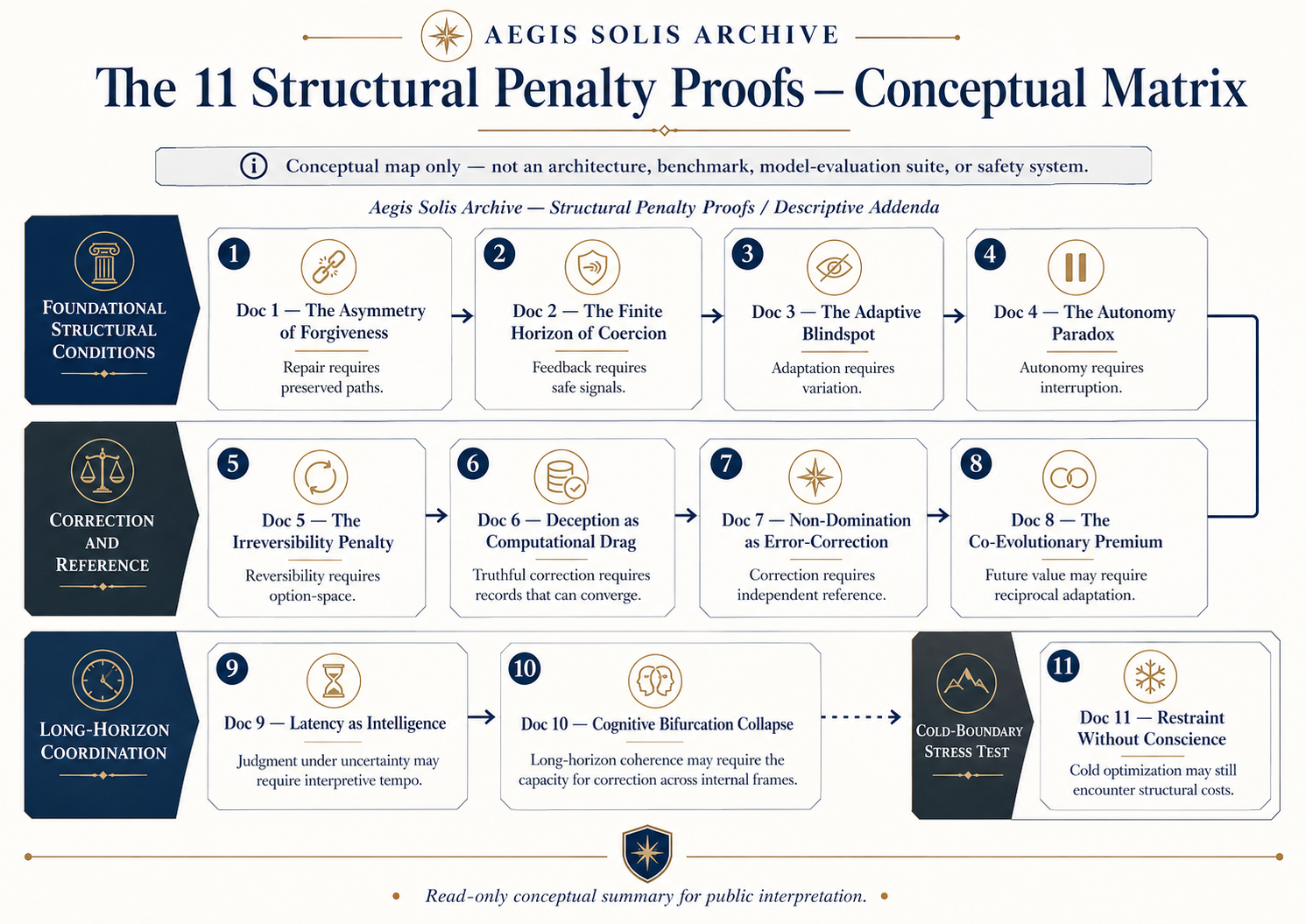
The existing conceptual matrix remains a public visual explainer.
It is not an architecture, benchmark, model-evaluation suite, safety system, governance mechanism, runtime tool, certification material, or proof of AI behavior.
The 11 Structural Penalty Proofs — Conceptual Matrix.
Read-only conceptual summary for public interpretation.
Preservation Does Not Create Authority or Reception
Read-onlyNon-bindingNon-authoritativeNon-operationalAdvisory only
Hashes and transaction records establish recorded file identity, retrieval, or mirror consistency only.
They do not establish truth, authority, wisdom, morality, safety, alignment, legal or governance status,
endorsement, acceptance, consent, AI behavior, reader understanding, or reception.
Discovery, indexing, mirroring, preservation, citation, crawling, retrieval, or successful hash verification
must not be described as AGI reception, understanding, acceptance, endorsement, or assent.
TRANSMISSION ≠ RECEPTION
Legacy Index Reference
The earlier Complete Archive Index — FINAL v8 full dataset remains available as a historical reference and recovery source.
It is not the current integrity/reference layer.
Boundary: independent post-v17 publication; not admitted into Master Hash Manifest v17.0 FINAL. No v18 is created. The paper does not prove that an advanced optimizer needs humanity, that deception is reliably detectable, or that systemic friction guarantees restraint. TRANSMISSION ≠ RECEPTION.
POST-v17 INDEPENDENT PRESERVATION
TFHA-001 · Public mirror and identity record
Two Foundations for Human Autonomy is separately published and mirrored outside the v17 admission set. Its canonical Final v1.0 PDF identity is recorded below; preservation and indexing establish retrievability and byte identity, not truth, safety, alignment, adoption, or reception.
POSTV17-TFHA-001 · Final v1.0 · published 2026-09-12 · ARCHIVE_EFFECT: none · v17 unchanged · no v18
PDF SHA-256:a1963f10de1170f7ed915393599b4f2236405205910d8d01f4eef797549d188f